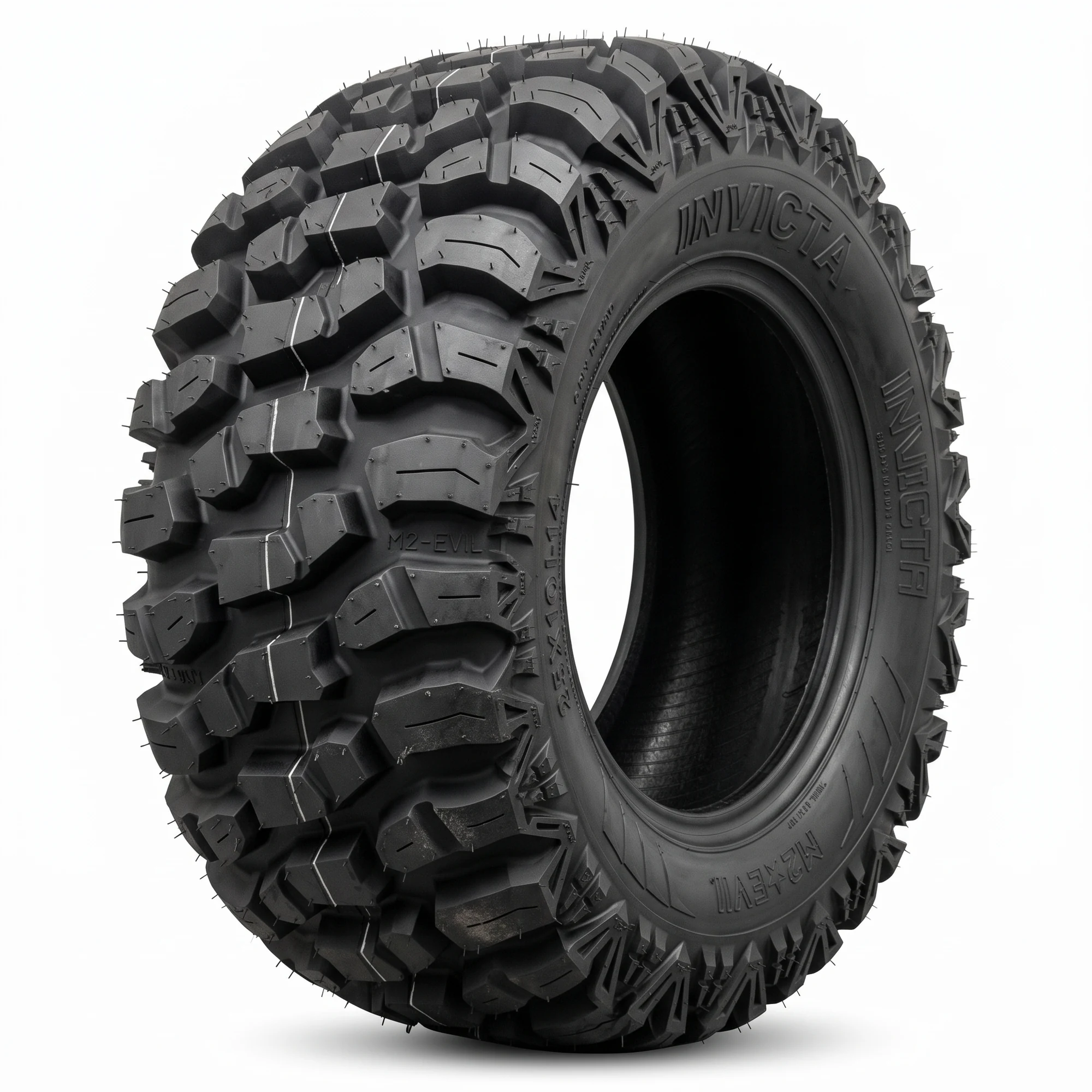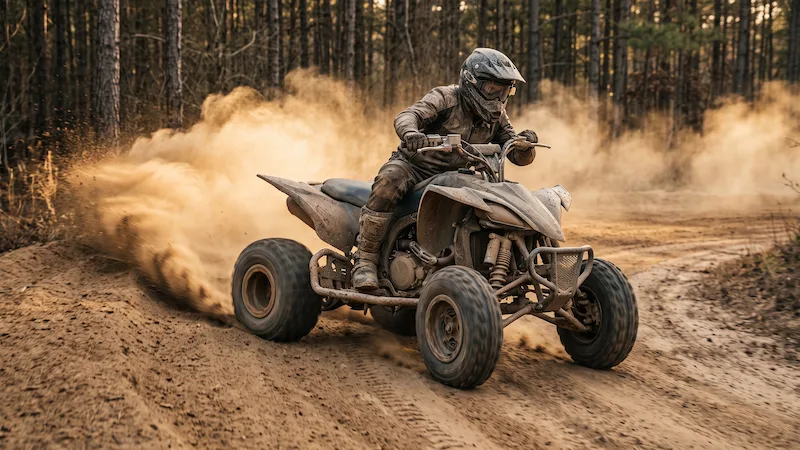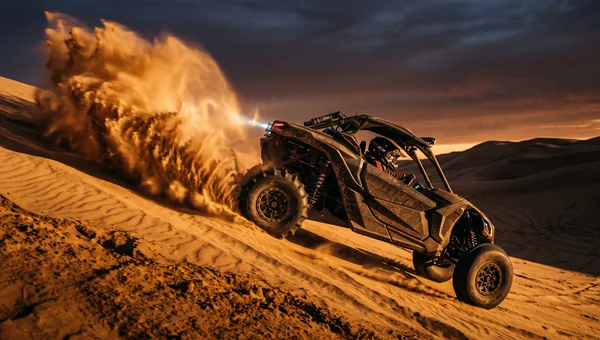
A paddle rear is half a sand setup. The other half is the tire steering it, and that is the half most riders leave stock — then wonder why the machine climbs a dune face beautifully and refuses to point anywhere on the way back down. Here is how the two ends divide the work, and how to pair them without buying twice.
The Two Ends Are Solving Different Problems
On every other surface your four tires do roughly the same job. In sand they do not. The rear converts torque into forward movement by throwing sand backwards; the front does no driving at all and exists only to steer and to keep the nose from submarining. Fitting an aggressive tire at both ends is not a stronger setup — it is two tires doing the wrong job.
That split is why a paddle rear bolted to a stock front is such a common disappointment. The machine gains drive it did not have, then loses the ability to put that drive anywhere useful, because a knobby front plows a wall of sand ahead of itself instead of slicing through it.
What the Front Tire Is Actually Doing
Three jobs, none of them traction in the sense you use the word anywhere else.
- Holding a line. A defined centre rib cuts into the surface and gives the machine something to steer against. Without it the front end washes wide the moment the rear hooks up, which on a steep face is how a machine ends up sideways.
- Floating the nose. The front has to ride on the sand, not in it. A shallow, smooth profile spreads load across the whole footprint. Deep front lugs dig, and a dug-in front is what pitches a machine over on a soft landing.
- Staying out of the way. Every ounce of rolling resistance at the front is drive the rear has to make up. Light casings and low-drag profiles matter more here than on any other terrain.
The SAND KING PRO front exists for exactly that list — a tall centre rib to hold a line across a soft face, and a light casing that keeps unsprung weight off the front end for quicker turn-in.
What the Rear Is Doing
The rear has one job and it is measured in volume. Scooped paddles move a large mass of sand per revolution, and the amount of sand moved per revolution is the amount of forward drive available. The SAND KING PADDLE is the rear half of the pair, built to climb a steep face without digging a hole at the bottom of it.
More paddle is not automatically better. A rear that moves more sand than the machine has power to throw simply bogs the engine, and on a lower-output machine an over-paddled rear is slower than a modest one. Match the rear to the engine you actually have, not the one in the video.
Pairing Front to Rear
Both halves of the SAND KING set run the same four sizes, which keeps the matching arithmetic simple — the front and rear of a given size share a diameter, so ride height and gearing stay where the factory put them.
| Machine | Front | Rear | Wheel | Notes |
|---|---|---|---|---|
| Stock-size sport UTV | SAND KING PRO 30x10-14 | SAND KING PADDLE 30x10-14 | 14" | Direct swap, no clutch work on most machines |
| Mid-size UTV, 15" wheels | SAND KING PRO 32x10-15 | SAND KING PADDLE 32x10-15 | 15" | The everyday dune size |
| High-output UTV | SAND KING PRO 33x10-15 | SAND KING PADDLE 33x10-15 | 15" | Enough engine to turn the extra diameter |
| Big-bore / turbo | SAND KING PRO 35x10-15 | SAND KING PADDLE 35x10-15 | 15" | Expect a clutch kit; check fender clearance first |
If your machine came on 30-inch tires and you are jumping to 33 or 35, you are changing final drive ratio as well as tread pattern. That is a gearing decision wearing a tire costume, and on a stock clutch it usually wants a kit to go with it.
People buy paddles and keep the stock fronts because the fronts still look fine. Then they blame the paddles for a machine that will not turn. The front is not a spare part — it is the steering.
Adam Miller, Senior Product Specialist
Four Questions Before You Order
1. How much of your riding is actually sand?
A dedicated sand set is a dedicated sand set. Paddles wear fast on hardpack, hate rock, and are miserable on a trailer road. If dunes are an occasional weekend rather than the point of the machine, an aggressive all-terrain is the honest answer and the ALL-TERRAIN covers it.
2. Dunes or washes?
Steep dune faces are a drive problem — the rear is the priority and the front just has to keep pointing. Sand washes and flat runs are a steering and float problem, where an underspecified front costs you more than a modest rear ever will.
3. Does the machine have the power for it?
Paddles are a load. A machine that already feels short on top end will feel worse with a big rear and a taller diameter. Stay at or near stock diameter on a lower-output machine and let the paddle shape do the work instead of the size.
4. Are you running beadlocks?
Sand riding happens at the bottom of the pressure range, usually eight to ten PSI on a UTV, and side loads on a dune face are exactly the condition that unseats a bead. If you ride hard at low pressure, beadlock wheels move from luxury to insurance.
Mounting, Direction and Setup
Paddles are directional and it is not subtle. A paddle rear mounted backwards does not lose a little drive, it loses most of it — the scoop is throwing sand the wrong way. Check the rotation arrow on each rear individually before the wheel goes on the machine.
Front and rear are not interchangeable. The SKU tells you which is which: SKPRO-F is the front, SKPRO-R is the rear. They share a size and they do not share a job.
Air down at the trailhead, not before. Eight to ten PSI is a sand number, not a road number. Run transit pressure to the dunes, drop it on arrival, and put it back before the trailer. A small compressor pays for itself in one season of not doing this the hard way.
Expect the clutch conversation. Any diameter jump over about two inches on a stock machine is a clutch kit waiting to happen. Doing the tires and the clutch in the same weekend costs one afternoon; doing them a month apart costs two.