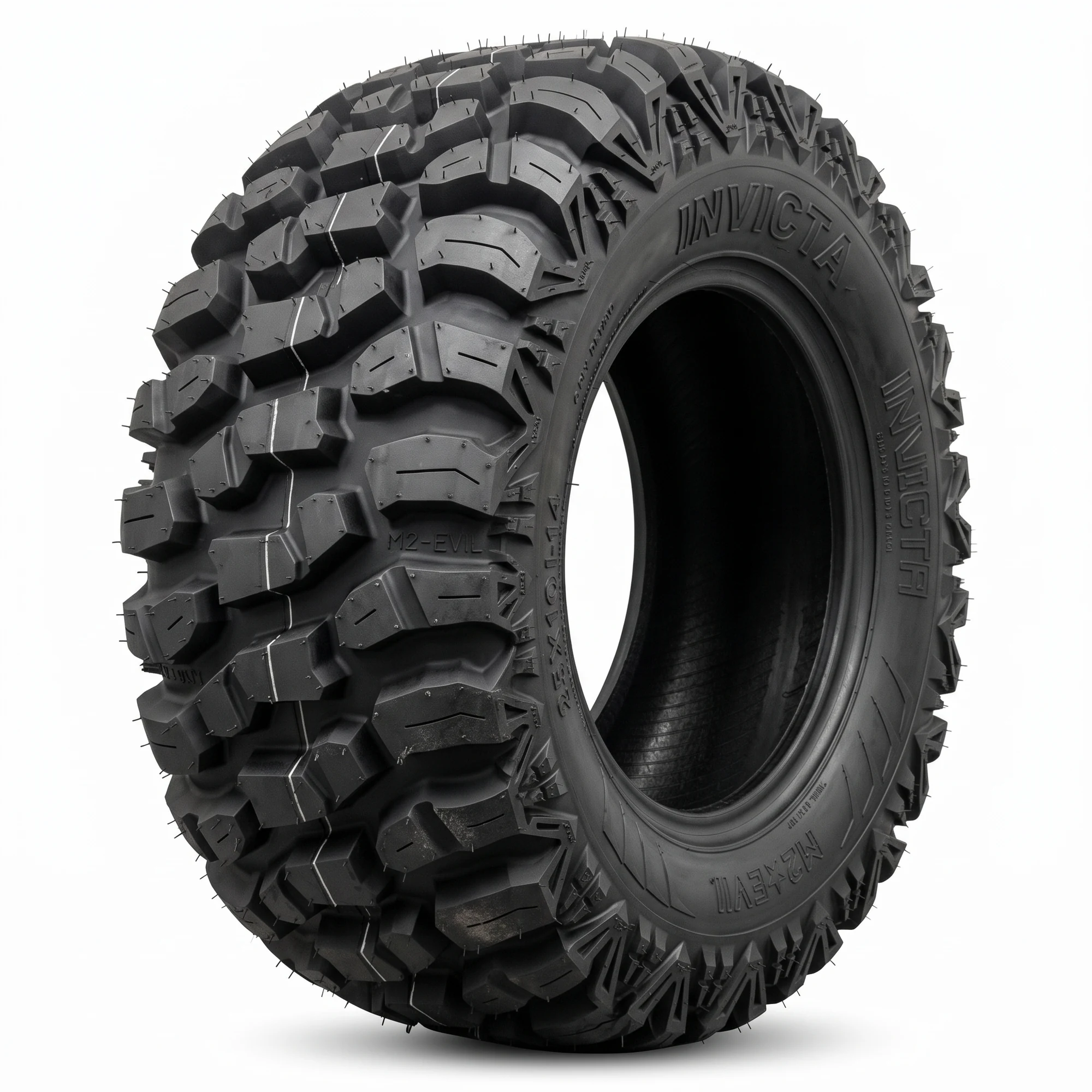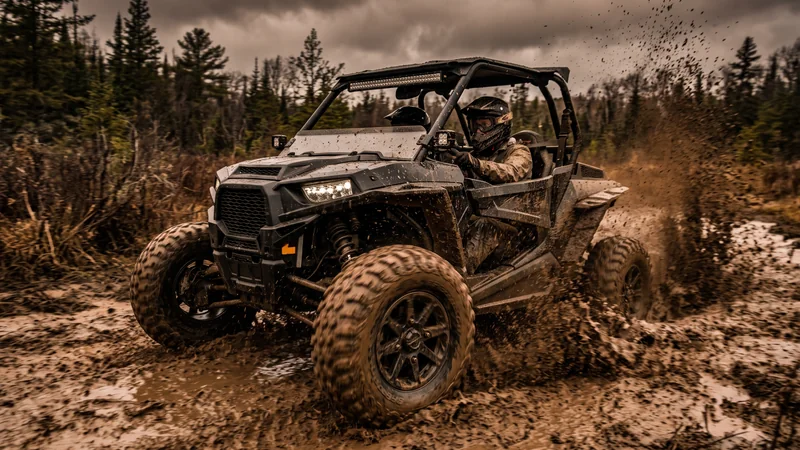
Not every tire sold as a mud tire clears mud. In two feet of clay a pattern that looks aggressive on the shelf will pack solid on the first revolution and spin a polished drum while the machine sits still. Here is what actually separates a self-cleaning tread from a tread that only photographs well — and how to read a tire before you buy four of them.
Why a Mud Tire Packs Out in the First Place
Saturated soil bonds to rubber under weight and torque. Once a lug void fills, the tread face becomes a smooth drum, and a smooth drum does not cut — it polishes. Every legitimate design choice in a mud tire exists to break that bond before the lug comes back around to the ground.
That is why lug depth alone is a poor buying signal. A two-inch lug that packs solid on the first revolution is doing less work than a one-and-a-quarter-inch lug that throws its load clear every time it leaves the ground. Depth sells tires. Void geometry moves machines.
The Three Things That Actually Clear Mud
Look for all three of these on any tire you are considering for real mud use. Two out of three is an all-terrain tire wearing a marketing badge.
- Void width between lugs. The gap has to be wide enough for centrifugal force to fling the load out before the next lug contacts the ground. Narrow all-terrain spacing fills on the first revolution and stays filled.
- Lug taper. A lug with straight vertical walls traps mud against itself. A tapered lug — wider at the base than at the tip — releases its load instead of gripping it, which is why taper matters more than the tread depth number stamped on the sidewall.
- Staggered side knobs. Side lugs that extend past the tread face grip the wall of a rut. Without them the machine sinks to the axles and the tires spin a cylinder-shaped hole while going nowhere.
Beyond those three, ply rating, carcass construction and lug angle change how the tire behaves in specific mud types — which is where most buying decisions actually go wrong.
Mud Is Not One Surface
The tire that dominates a sandy swamp trail can be completely wrong for tight river-bottom clay. Composition changes the whole problem.
Clay and Gumbo
The hardest case. Fine particles pack under pressure and cure into something closer to a ceramic than a soil. Here you want the widest voids and the most aggressive taper you can live with on the road. Self-cleaning is not a feature on clay — it is the entire specification.
Sandy and Loamy Mud
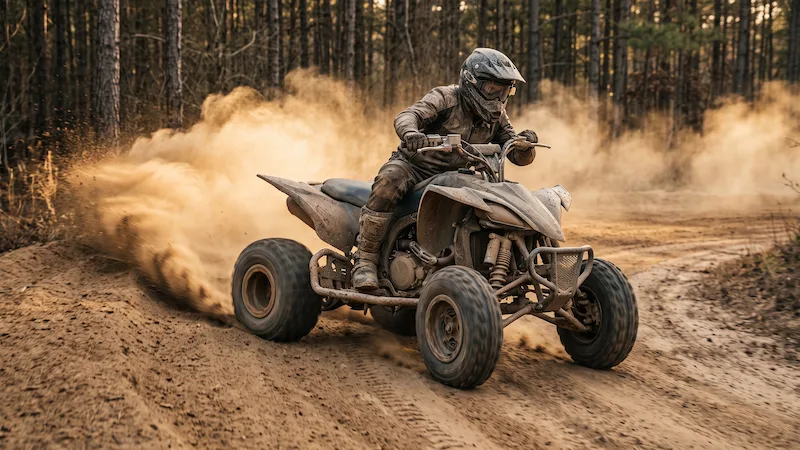
Looser particle structure means the tire sheds most of its load naturally. You still need lug height for bite, but side-knob prominence matters less. A true mud tire here is more aggressive than the terrain requires and will wear faster on the dry sections between the wet ones.
Rocky Mud
Creek bottoms, rock ledges and sticky red clay on the same ride. Tall individual lugs tear on rock edges. This is where a radial carcass, a lower-profile lug with a wide base, and an eight-ply construction pay for themselves twice over.
How the Invicta Line Stacks Up
Same test loop, same machine, same weekend. Here is where each of our mud-capable patterns landed.
| Tire | Lug Height | Construction | Best For | Self-Cleaning |
|---|---|---|---|---|
| M2 EVIL | 1.75" | 8-ply Radial | Clay, deep bogs | Excellent |
| BLACKTAIL | 2.0" | 6-ply Bias | Extreme deep mud | Excellent |
| BLACKWIDOW | 1.25" | 6-ply Bias | Light mud, mixed trail | Good |
| M2 EVIL – ATV | 1.6" | 8-ply Radial | Rocky mud, mixed terrain | Very good |
| ALL-TERRAIN | 0.9" | 6-ply Radial | Occasional mud, mostly trail | Limited |
The moment a mud tire packs out you are just spinning rubber. Wide voids and tapered lugs are not optional — they are the entire design mission.
Adam Miller, Senior Product Specialist
Four Questions That Pick the Tire For You
Stop reading best-of lists and answer these about your own riding.
1. What percentage of your riding is actually mud?
Under thirty percent, an aggressive all-terrain handles it without the road noise and wear penalty — the ALL-TERRAIN is that line. Between thirty and seventy percent, you are in true mud-tire territory and the M2 EVIL is the balanced answer. Over seventy percent deep mud, run the BLACKTAIL and accept the road manners that come with it.
2. What is your terrain base material?
Clay wants the tallest lug and the widest void you can run. Sand and loam want a standard mud pattern without over-investing in depth. Rock mixed with mud wants a lower-profile, wide-base lug and eight-ply radial construction as a minimum.
3. What size will your machine actually take?
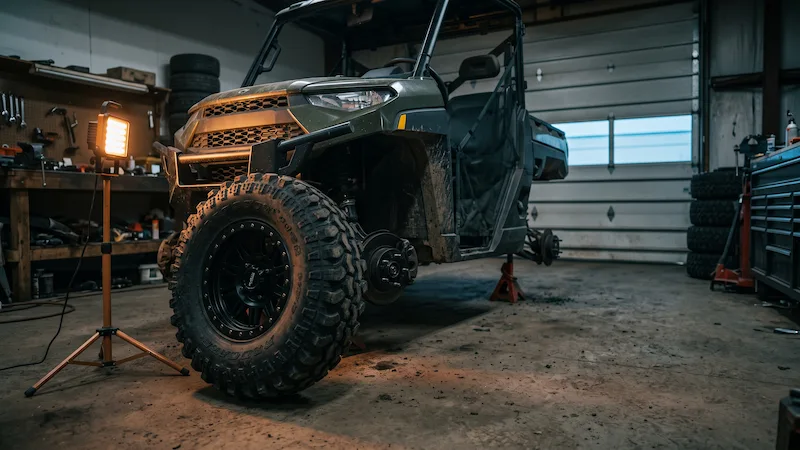
The widest tire that fits gives you the most contact patch, but check wheel offset and fender clearance before you commit. Diameter changes gearing and final drive load, and on a stock machine a jump of more than two inches usually means a clutch kit as well.
4. What is the real budget?
Wholesale pricing puts genuine eight-ply radial mud tires inside most riders' reach. The gap between wholesale and dealer retail on a premium mud tire runs forty to sixty dollars per tire — which means a set of four premium tires at wholesale costs about what a set of mid-grade tires costs at a local counter.
Mounting and Break-In
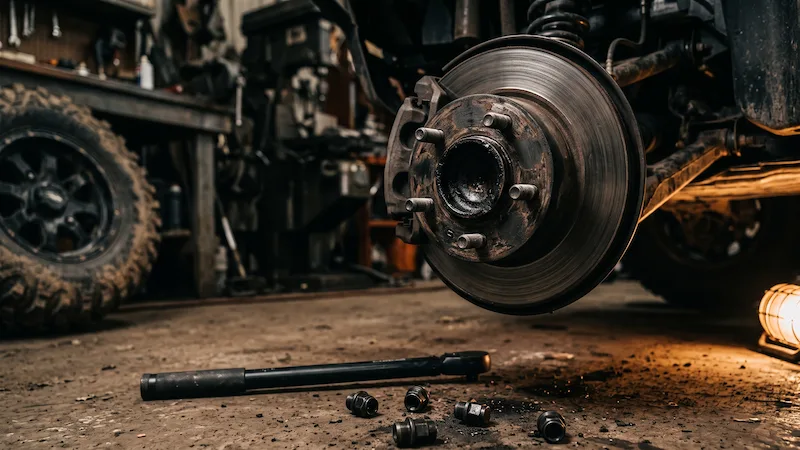
Direction matters. Directional mud tires carry a rotation arrow molded into the sidewall. Mounting one backwards halves its self-cleaning efficiency. On machines with staggered front and rear sizing, confirm direction for each axle position separately.
Run less pressure than you think. Most mud riding happens at eight to twelve PSI, not the eighteen to twenty-two recommended for trail or street. Lower pressure flattens the contact patch and lets the lugs dig instead of skim. Carry a gauge and learn your machine's number for each terrain.
Expect a short break-in. New rubber carries a release compound from the molding process. The first fifty to a hundred miles run slightly below peak grip, most noticeably in the wet. That is normal and it goes away.