Two wheels with the same bolt pattern and the same diameter can put a tire in two completely different places. Backspacing and offset are the numbers that decide it, and one of them you can measure with a tape in your own garage in about ten minutes.
Two Ways of Saying the Same Thing
Backspacing is the distance from the wheel's mounting pad to the inner lip of the rim, measured in inches. Offset is the distance from that same pad to the centreline of the wheel, measured in millimetres, and it carries a sign. Positive offset puts the pad outboard of centre and tucks the tire in. Negative offset puts the pad inboard and pushes the tire out.
They describe one physical thing from two directions, and converting between them takes a single subtraction. Overall wheel width is the stated width plus roughly an inch for the two bead flanges, so a 14x7 measures about 8 inches lip to lip. Offset in inches is backspacing minus half that overall width. A 14x7 with 4 inches of backspacing sits at zero offset. Drop to 3 inches of backspacing and you are an inch negative, and the tire has moved an inch further out.
Why Sellers Use Both
Powersports wheels are usually advertised in the plus format, as 4+3 or 5+2, which is backspacing plus front spacing. A 4+3 is a 7 inch wheel with 4 inches behind the mounting pad. Automotive wheels are sold in millimetres of offset because that is what fits on a stamping. Neither is more correct, and you will meet both in the same afternoon of shopping.
What Moving the Tire Outboard Does
Wider track, better stability, more room between the tire and the radius rod. Then the bill arrives.
- Steering effort goes up. The contact patch moves further from the steering axis, so every rut gets more leverage over the wheel and your arms take more of the work.
- Bearings and ball joints see more load. Same weight, longer lever. This is the most common reason a machine starts eating front bearings after a wheel change that otherwise went fine.
- Fender coverage runs out. The shoulder lugs end up level with or past the fender edge, which puts mud on the doors and on the occupants, and finds the fender lip at full lock.
And Moving It Inboard
Tucking the tire under the machine buys fender clearance and lighter steering, then spends it on suspension clearance. The tire tracks toward the radius rod, the A-arm and the shock body at exactly the moment the suspension compresses and that space is smallest. On a taller tire it is also the moment the sidewall is bulging its widest.
A narrower stance changes behaviour too. Less resistance to roll on a side hill, quicker steering response, and a car that feels twitchier at speed over washboard.
Four Wheels, Four Places the Tire Sits
One tire, four common wheel specs, run through the conversion above.
| Wheel | Backspacing | Offset | Where the Tire Ends Up |
|---|---|---|---|
| 14x7 4+3 | 4" | 0 mm | Centred on the hub, the common stock-style setup |
| 14x7 3+4 | 3" | −25 mm | An inch further out, wider stance, heavier steering |
| 15x7 5+2 | 5" | +25 mm | An inch further in, watch the radius rod at compression |
| 15x8 4+4 | 4" | −13 mm | Half an inch out, with an inch more tread width than the 7 |
Look at the last row. Wheel width changes offset even when backspacing stays put, because the centreline moved instead.
Riders shop bolt pattern and diameter, then wonder why the new wheels rub when the old ones never did. Backspacing is the number nobody writes down and the one that decides it.
Adam Miller, Senior Product Specialist
Spacers Are a Tool, Not a Fix
A spacer moves the whole wheel outboard by its own thickness, so a 1.5 inch spacer is a 38 millimetre offset change carrying every consequence listed above. Used deliberately, to clear a specific interference or to widen a stance you want widened, they work fine.
Used to rescue a wheel purchase, they stack problems. You need studs long enough for the nuts to fully engage through the spacer, a spacer that pilots on the hub rather than hanging on the studs, and the discipline to re-torque after the first ride and after the first few heat cycles. Skip any of that and the failure is not gradual.
Measuring Yours in Ten Minutes
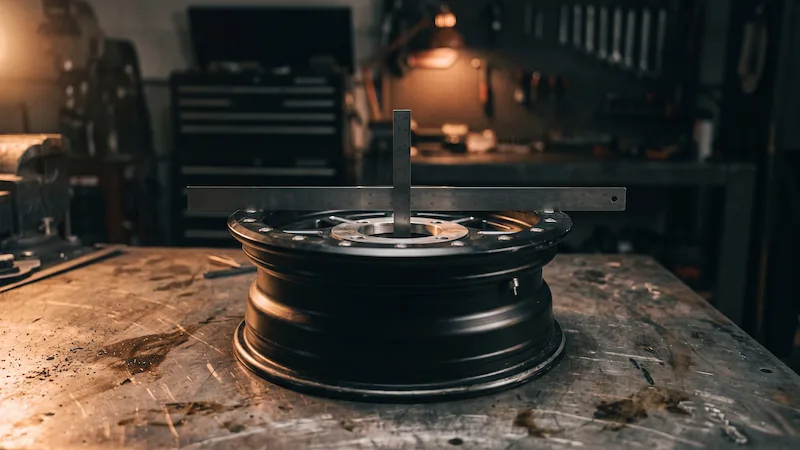
Lay the wheel face down. Tire on or off makes no difference to the measurement, though off is easier to work with.
Bridge the inner lip with a straightedge. Measure straight down from the straightedge to the mounting pad. That distance is your backspacing.
Measure the overall width lip to lip. Use what your tape says rather than the advertised width, because the flange allowance varies between makers.
Subtract half the overall width from the backspacing. The result is offset in inches, so multiply by 25.4 for millimetres. Keep the sign, because the sign is the entire point.
Write those figures on a card and keep it with the machine's paperwork. Every future wheel or tire question gets faster to answer, and none of them get answered by looking at a photo of somebody else's car.