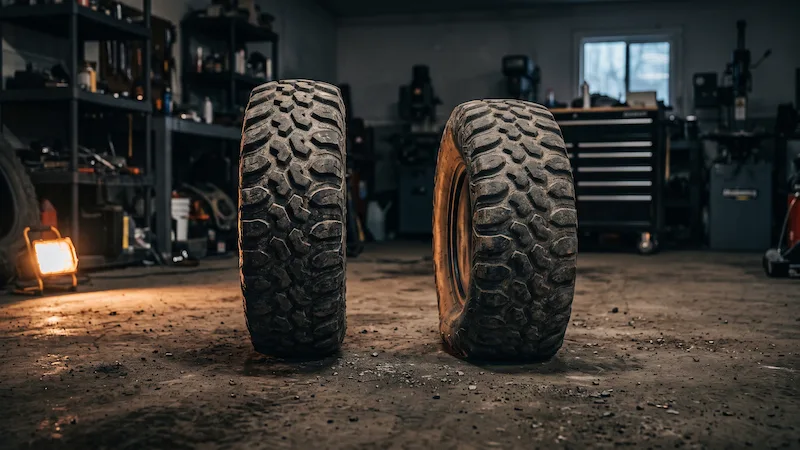
Two tires can share a size, a lug pattern and a price and still behave like different products. The reason is usually the angle of the cords buried inside them. Radial or bias is the first decision worth making on a new set, ahead of tread depth and a long way ahead of brand loyalty.
The Difference Is the Angle of the Cords
In a bias tire the plies run bead to bead at roughly thirty to forty degrees, crossing each other on the way. Tread and sidewall end up as one structure. Flex the wall and the tread face moves with it, which is why a bias tire feels like a single stiff hoop.
A radial runs its body cords straight across the tire at ninety degrees to the direction of travel, then lays belts under the tread. Now the sidewall flexes on its own and the tread stays flat on the ground while it does. Every trade-off below comes out of that one difference in construction.
What It Feels Like From the Seat
A radial takes the chatter out of gravel, tracks straighter at speed, and keeps its tread planted when one side drops into a rut. A bias tire feels firmer and more direct, holds the machine up when you lean on it hard, and lifts its tread edges off the ground as soon as you air down. Neither of those descriptions is a criticism. They are the personalities you are choosing between.
Where Radial Earns Its Money
Four things, and the first one drives the rest.
- Footprint when you air down. Drop the pressure and a radial lengthens its contact patch while the tread face stays flat. A bias tire crowns instead, so you get less patch for the same air you let out.
- Heat. Belts and an independent sidewall run cooler over long fast miles. Heat is what ends most tires that do not get cut, so cooler running shows up later as tread still being there.
- Even wear. Less centre cupping, less shoulder scuffing, and a wear pattern that stays readable for the whole life of the set.
- Cleaning. A flat tread face means the whole lug row leaves the ground together and throws its mud load together. On a crowned bias tread the centre lugs unload first and the shoulders keep their packing.
Where Bias Still Wins
The case for bias is not nostalgia, whatever the radial marketing suggests.
Sidewall cuts. Crossed plies put more material at exactly the angle a rock edge attacks. In shale and on ledges a six-ply bias wall survives strikes that open a comparable radial, and that is the single most common way a tire dies in rock country.
Price. Fewer manufacturing steps and simpler tooling. On an ATV budget the difference buys most of a fifth tire.
Sidewall support under load. Put a hundred pounds of feed on the racks and lean the quad through a rutted turn. The bias wall resists rolling under in a way a soft radial wall does not.
Casing by Ride
The short version, mapped onto what we stock.
| Ride | Casing | Tire | Reason |
|---|---|---|---|
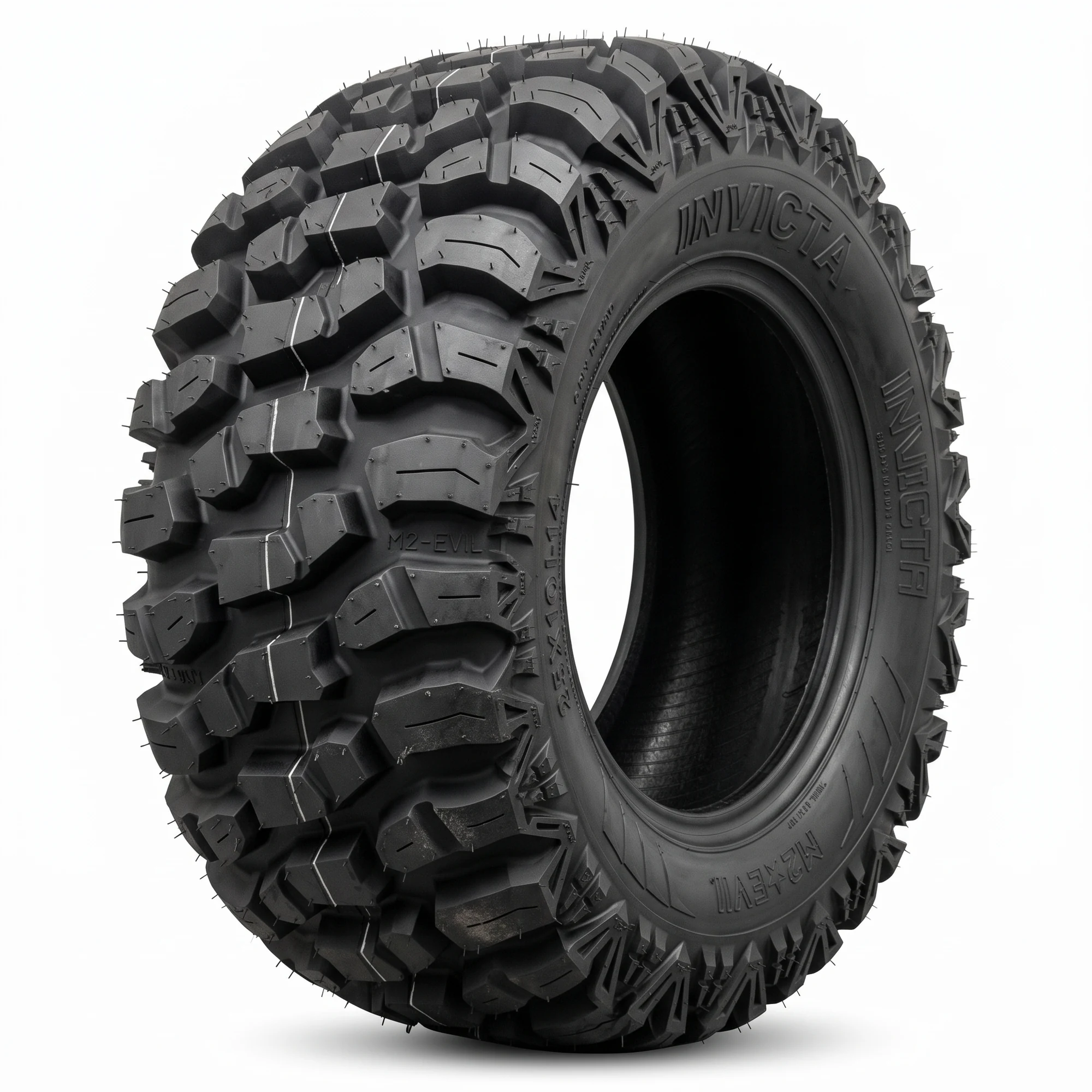
| Deep clay and bog | 8-ply Radial | M2 EVIL | Flat tread face throws its load, casing shrugs off stump edges |
| Rock ledges and shale | 6-ply Bias | BLACKWIDOW | Crossed sidewall plies under wraparound shoulder lugs |
| Trail, gravel and road miles | 6-ply Radial | ALL-TERRAIN | Cool running, quiet, wears evenly across the tread |
| Utility quad with a working load | 6-ply Bias | BLACKTAIL | Sidewall holds its shape with weight on the racks |
| Deep mud on a quad | 8-ply Radial | M2 EVIL – ATV | Keeps steering feel instead of pushing straight on |
If you air down for terrain, buy radial. If rock is trying to open your sidewalls, buy bias. Most arguments I get into about this end at one of those two sentences.
Adam Miller, Senior Product Specialist
Do Not Mix Them on an Axle
Two casings on the same axle give you two rolling diameters under load and two different slip behaviours at the same throttle opening. On a locked rear or an engaged front differential that mismatch has nowhere to go except into the driveline, and it goes there as heat and wear.
Front and rear mixing is a different conversation. Some sand setups do it deliberately, with a hard paddle rear and a light front, and it works because the axles are being asked to do unrelated jobs. Same axle, though, is a hard no. Buy four of the same construction or buy two pairs that match across each axle.
What Changes the Week After You Switch
Your pressure numbers move. A radial reaches the same footprint on less air than the bias set it replaced. Start two or three psi lower than your old number and work down from there with a gauge, not by eye.
It will look flat. A radial bulges near the bottom of the sidewall because the wall is doing its job independently of the tread. Judge inflation by the footprint on the ground and the gauge reading, never by the profile in a photo.
Steering gets lighter, then vague. Radials reduce steering effort. Keep dropping pressure and the front end starts to feel like it arrives late. That point is your floor for that terrain, and it is worth finding on purpose in a field rather than by surprise on a hillside.
Overinflation moves the wear. A hard bias tire wears its centre. A hard radial scuffs its shoulders, because the belts hold the tread flat while the sidewalls stop absorbing anything. Check the shoulders at the first oil change after the swap and adjust from what you see.